Lightyear @ NFD40: Buying Bandwidth Shouldn't Suck
 5 May 2026 · 11 min read
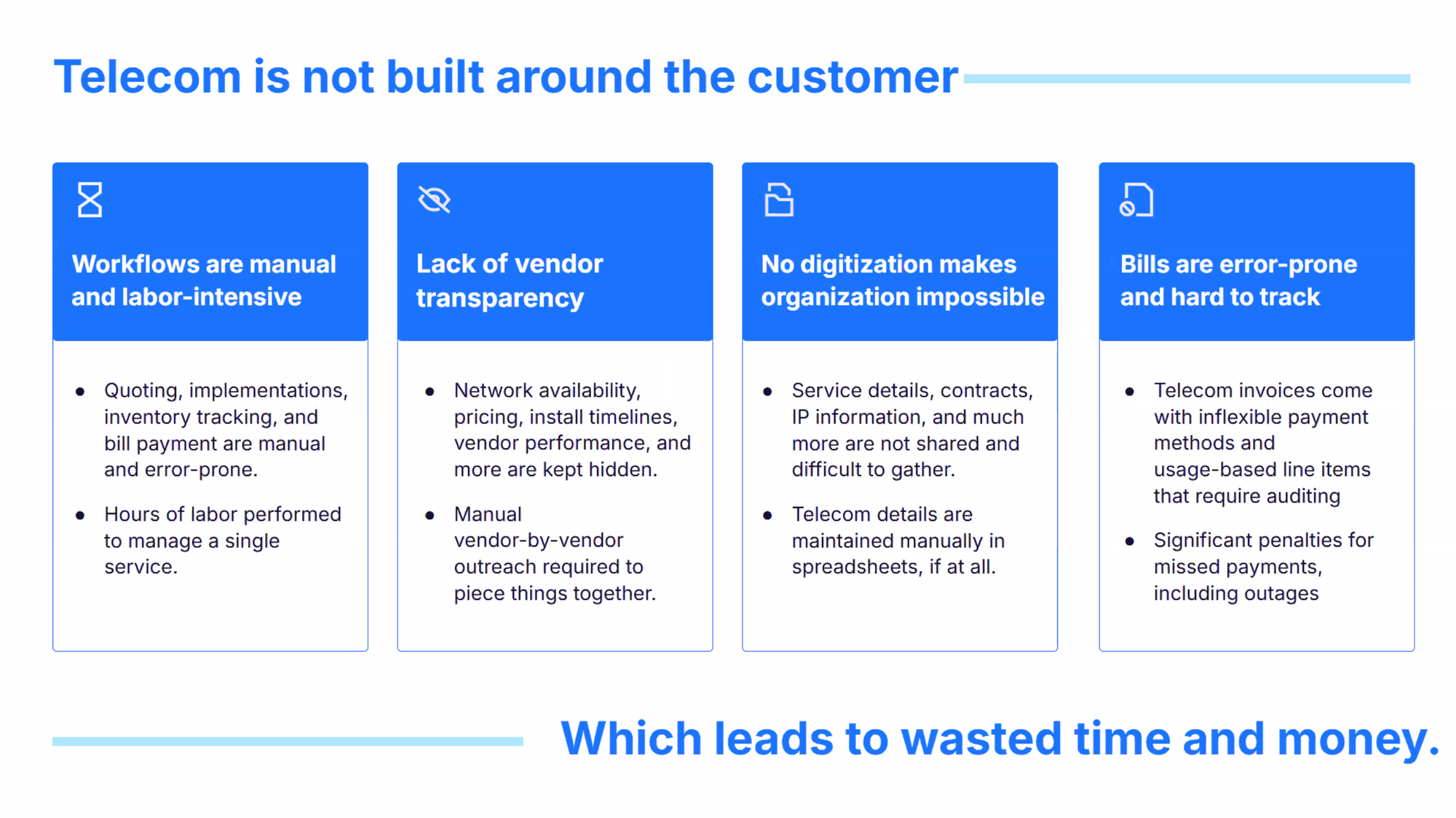
Every network engineer doing this work for any length of time has a telecom procurement horror story. The circuit that took six months to install. The carrier that quoted three different prices before even getting the address right. The circuit that auto-renewed at twice the price because nobody was tracking the contract end date because you're on your 5th carrier sales rep in 3 years. Those who have dealt with telecom procurement have all been there, staring at spreadsheets of carrier quotes and wondering why this process still feels like it's stuck in 2005.
Lightyear says there's a better way. And at NFD40, sandwiched between presentations about 102.4T switching silicon and AI fabric architectures, their session was a reminder that some of the most valuable problems in networking sometimes aren't the sexy ones. They're the ones we've been living with for so long we almost forgot to be annoyed. Almost.
Three Products with One Lifecycle
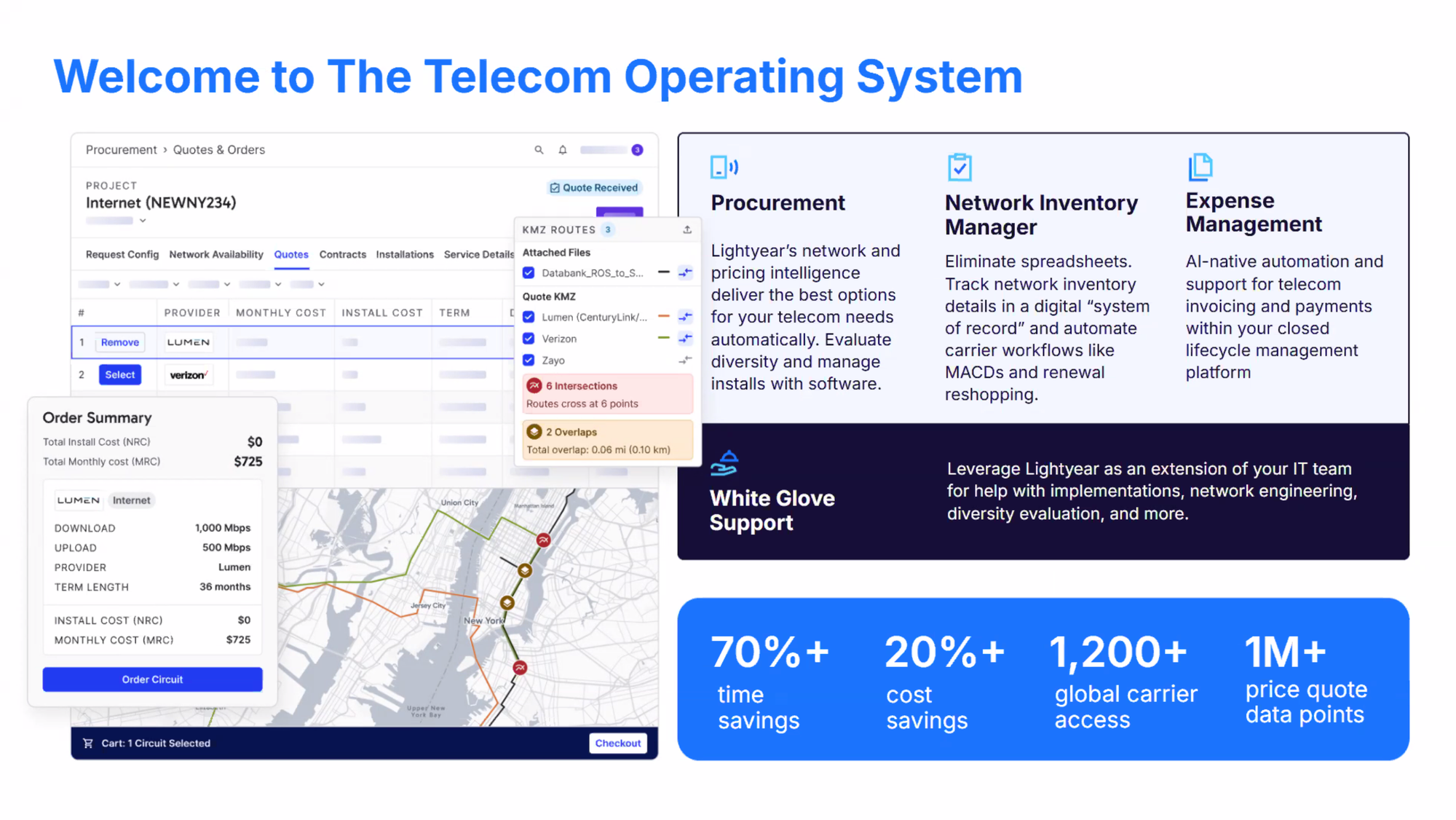
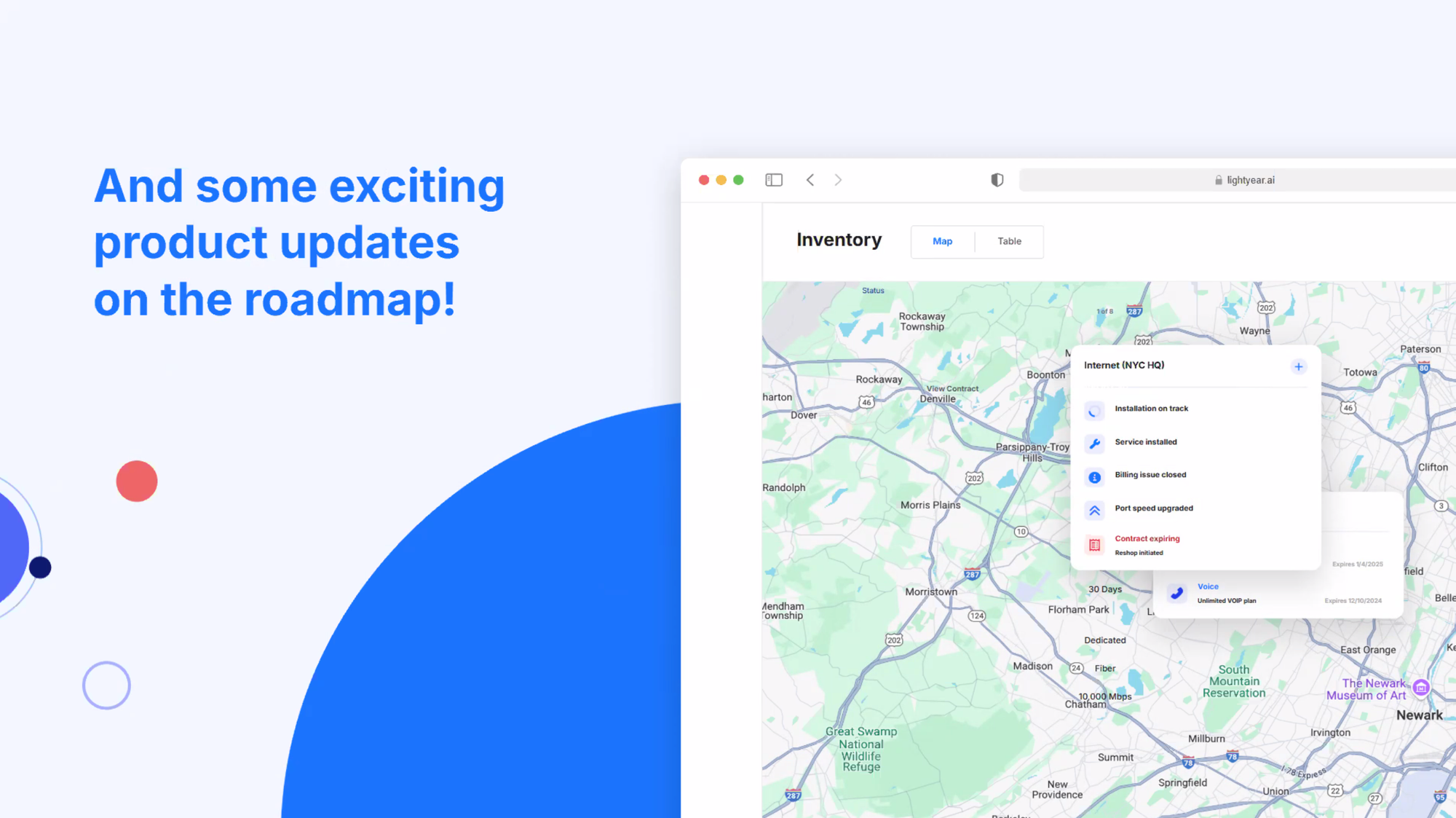
Lightyear is building what they call a "Telecom Operating System". That's an ambitious claim but the product behind it is pretty legit. Light year has three integrated products that cover the full lifecycle of enterprise network connectivity.
- Procurement is the flagship and it's free to use. You create a digital RFP, Lightyear's backend uses location intelligence and pricing data across 1,000+ provider integrations to identify who's on-net or near-net at your site, bids it out, negotiates if pricing looks off and presents you with a side-by-side comparison. The commission that funds this would otherwise go to the carrier sales rep so it doesn't increase your cost. The diversity validation is particularly interesting in that they have true data analysis to verify actual route diversity, not just "the carrier says it's diverse." Anyone who's discovered their "diverse" circuits running through the same conduit that gets whacked during construction knows why this matters.
- Network Inventory Manager is the system of record for telecom most of us wish we had. Over 30 data points tracked per service (contract terms, static IPs, account IDs, renewal dates), automated lifecycle workflows for Moves, Adds, Changes & Disconnects (MACDs), contract renewals and API integrations with ServiceNow and Netbox. It plugs into the tools enterprises already run instead of asking you to adopt yet another portal, plus it's brownfield friendly. So no forced circuit replacements, your existing network gets onboarded in current state.
- Expense Management is what they call "AI-native" telecom invoice processing. LLMs with RAG optimized on telecom data extract and bucket every line item from carrier invoices, match them to actual inventory services and flag variances automatically. Taxes vs. government surcharges vs. actual service cost, all broken out. If you've ever tried to reconcile a telecom bill that doesn't match the contract (so, like, every telecom bill), having software that automates the matching and chases down disputes is genuinely useful.
Lightyear claims 400+ enterprise customers including Mattel, TEGNA, Five Guys, Palo Alto Networks and Fortune 100 companies are using the platform today. Definitely some notables who are bought in.
Show Me the Workflow
Dennis Thankachan (CEO, presenting remotely... boo!) and Ryan Schrack (CTO, in the room) committed to a live demo of all three products and they delivered.
Seeing the procurement workflow end-to-end was very valuable and helped really understand how things work. The platform walks you through RFP creation, pulls real-time provider coverage data, runs on-net/near-net/off-net probability algorithms, shows diversity analysis with actual KMZ path visualization and lets you compare quotes side by side. It's the process most of us do manually over weeks in spreadsheets, compressed into a software workflow you can kick off in about a minute.
The install project management piece was a nice touch. Lightyear tracks every job step for every circuit install across every carrier, flags action items that need your attention and has an implementations team using proprietary escalation paths when things stall. As Dennis put it, installations are "the bane of a network manager's existence." Having lived a few, he's not wrong.
The expense management demo parsing a Lumen invoice and automatically itemizing charges against inventory services was solid. Watching it flag variances in real time and route them to dispute workflows is the kind of thing that would save a finance analyst serious hours every month.
The Data Advantage
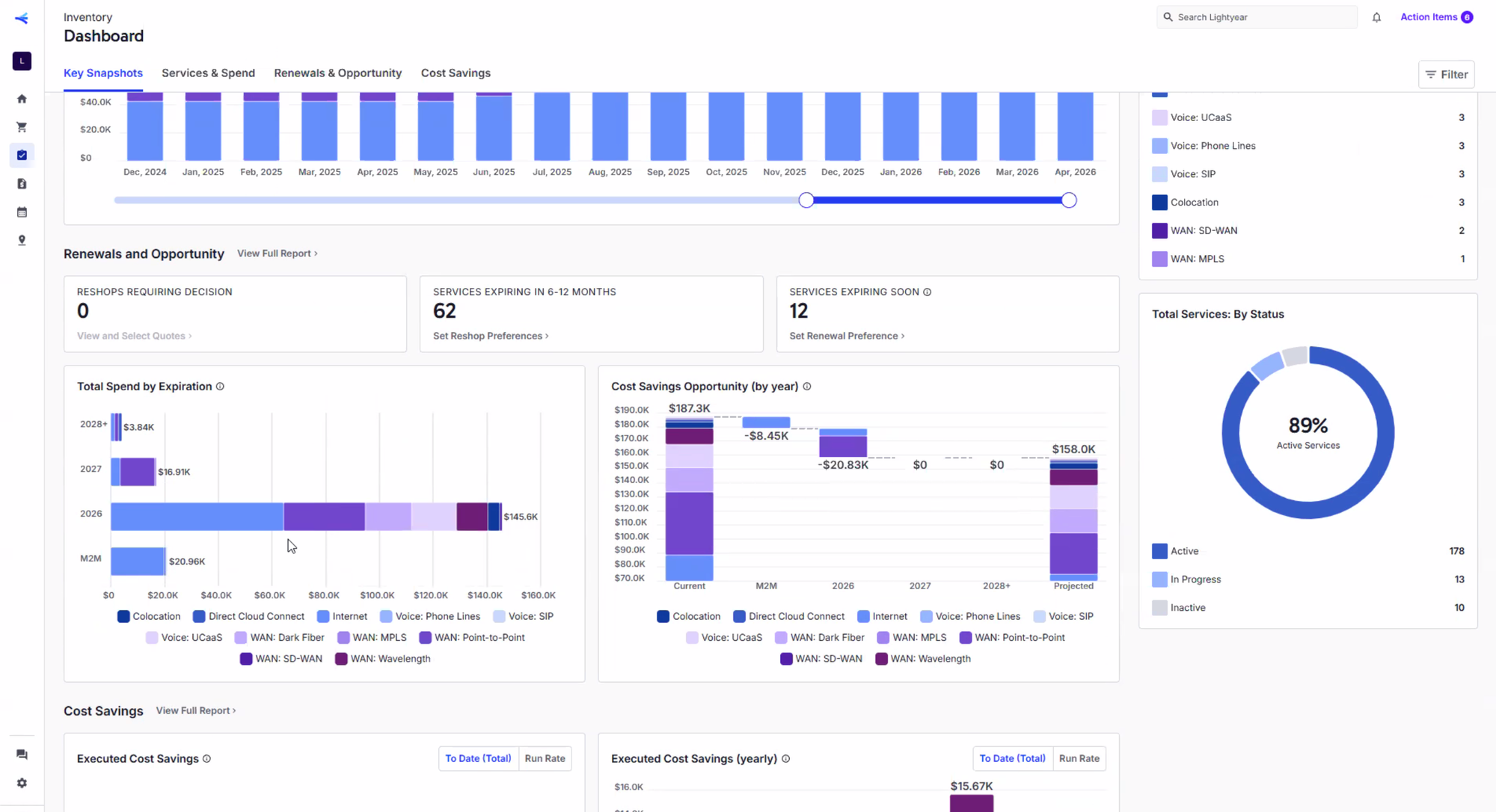
The most interesting thing about Lightyear might not be the software itself, I think it's actually the dataset underneath it. They process over 100,000 RFPs annually across 1,000+ providers which generates pricing intelligence, provider coverage maps and trend data that individual enterprises simply can't replicate on their own.
Their State of Connectivity Report draws on this data to publish industry-wide trends in enterprise telecom pricing and provider availability. For network teams trying to benchmark whether they're getting a fair deal on a circuit, that kind of data is pretty sweet.
The provider coverage intelligence is also pretty cool. Given a specific address, Lightyear can tell you which carriers service that location, whether you're on-net or near-net and what the likely pricing range is. For multi-site enterprises procuring circuits across dozens or hundreds of locations, this replaces what used to be a very manual, very slow discovery process.
The Agent Question
Fellow delegate Tony Mattke asked the question that was probably on everyone's mind: how is this different from a traditional telecom agent? Which is a fair challenge. The commission structure is similar.
Dennis made two points:
- First, Lightyear will sell providers even if they pay them zero commission. This is a meaningful difference from agents whose biggest incentive is to keep services billing indefinitely or only show carriers that get them the most commissions (i.e. SPIFs from carriers with promos or the promise of a trip somewhere exotic)
- Second, the software platform handles enterprise-scale operations (hundreds of sites, complex diversity requirements, systematic quoting) that most individual agents simply can't manage. But as Tony pointed out, some very good agents manage thousands of circuits just fine. The distinction is real but not absolute.
I asked about cloud expense management (AWS, GCP, Azure) and got a clear "no, that's out of scope" which I appreciated. They also don't do logical/AS-level diversity analysis in an automated way, though their solutions engineering team handles it in a consultative way for more network centric customers. Both honest answers about product boundaries, which earns more trust than promising things that can't be delivered or sweeping it under the rug.
From Invoice OCR to Network Monitoring
Lightyear's AI story has evolved in stages. They started with statistical models for pricing prediction and OCR for invoice processing. Today they're using LLMs to automate unstructured carrier communications: the messy email threads and PDF quote attachments that make telecom procurement feel like a time warp.
Ryan walked through roadmap plans for a circuit monitoring pillar covering capacity utilization and uptime tracking. The vision is to close the loop: don't just procure the circuit, also monitor its performance then auto-create tickets when SLAs degrade and trigger re-procurement when contracts expire.
That's a significant surface area expansion from where they are today and it's worth watching how they execute. With the procurement and expense management products proven, the monitoring capabilities on the 2026 roadmap really become compelling. It's a natural extension since you can't manage SLAs effectively without knowing what you bought and what you're paying for it.
The Problem Underneath the Infrastructure
NFD40 was dominated by AI networking. Fabric architectures, switching silicon, AIOps philosophies. Lightyear was the one presentation that zoomed out and addressed the infrastructure layer beneath all of that: the physical circuits connecting data centers, branches and cloud on-ramps.
If the industry is moving toward geo-distributed GPU clusters, someone has to procure the DCI circuits connecting those sites. That procurement process is exactly what Lightyear automates. It's not glamorous, but it's essential. And automating it frees up network engineers to spend their time on the interesting problems instead of chasing carrier reps for the third time this week.
Wrapping Up
Lightyear's NFD40 session was a reminder that not every important networking problem involves 800G optics or AI-driven root cause analysis, even though our feeds are full of just that. Some of the biggest time sinks in our field are painfully mundane: buying circuits, tracking renewals, reconciling invoices. The fact that it took until recently for a startup like Lightyear to seriously attack this problem tells you how long we've all just accepted the pain.
If you manage telecom procurement for an enterprise (or you know someone who does), the Lightyear demo is worth your time. You'll recognize the problems immediately. And you might be surprised how far the solution has come.
DISCLAIMER: I was fortunate to participate in Network Field Day 40 as a delegate by Gestalt IT who put me up in San Jose California, bought me food, paid for snacks and left me some cool swag from the participants. I did not receive any compensation to attend this event and I am under no obligation whatsoever to write any content related. The contents of these blog posts represent my personal opinions about the products and solutions presented during NFD.
More NFD40 Content From My Esteemed Delegate Peers!
Tony Mattke
 Tony Mattke
 Tony Mattke
 Tony Mattke
 Tony Mattke
 Tony Mattke
Ben Story
 Ben Story
 Ben Story
 Ben Story
 Ben Story
 Ben Story
Peter Welcher
 Peter Welcher
 Peter Welcher
 Peter Welcher
 Peter Welcher
 Peter Welcher